


FROM SWISS BASEMENT TO JAPANESE THRONE
Updated: Jun 21
Swiss traditions reimagined through Japanese life
If you’ve ever visited Japan, you’ve probably encountered the country’s legendary high-tech toilets.
And if you haven’t, somebody has almost certainly told you about them in the tone normally reserved for spiritual awakenings.
'Heated seats!'
'Automatic lids!'
'It plays waterfall sounds while you do your business!'
Western travel articles and blog posts love describing Japanese toilets as 'like operating a Boeing cockpit,' which is unfair.
A Boeing cockpit is probably easier.
The average Japanese toilet contains approximately seventeen buttons, several mysterious symbols, and at least one function that feels medically ambitious.
What most people don’t realise, however, is this:
The entire thing began with a Swiss man in a basement.
I'm sure you didn't see that coming.
His name was Hans Maurer.
In the 1950s, while most of Switzerland was busy making watches and remaining emotionally restrained, Maurer looked at toilet paper and thought:
'There must be a better way.'
His solution involved a water jet and a warm-air dryer.
Which today sounds perfectly reasonable.
At the time, however, it made him look insane.
According to reports, his first prototype consisted of a garden chair, plastic tubing, and a hair dryer. His wife was so embarrassed by the project that she reportedly closed the curtains so the neighbours wouldn’t see what her husband was building in the basement.
Frankly, if I saw my neighbour attaching a hair dryer to a chair in 1950s Zurich, I would also have concerns.
Maurer called his invention the Closomat – a combination of 'closet' and 'automatic.'
His argument was simple: toilet paper merely moves the problem around. Water, meanwhile, actually cleans.
It was a surprisingly modern idea.
Unfortunately, 1950s Switzerland was not emotionally prepared for a man publicly discussing bottom hygiene.
When Maurer presented the Closomat at a trade fair in Basel in 1957, he was mocked, insulted, and reportedly even spat on.
Which feels particularly harsh for a toilet exhibition.
Sales were slow. Very slow.
In the first four years, he sold only around 300 units. His invention also suffered from what engineers politely call 'teething problems' and what customers saw as a non-starter.
Still, Maurer persisted.
This is another deeply Swiss trait: quiet stubbornness in the face of public humiliation.
Then, in the 1960s, Japan entered the story.
And suddenly everything changed.
Because Japan saw Maurer’s invention and reacted the way Japan often reacts to Western inventions:
'Interesting. We will now perfect this beyond all reason.'
The Japanese company Toto licensed the basic concept and transformed it into the now-famous Washlet.
And this is where things escalated.
The humble Swiss water jet evolved into a technological lifestyle experience.
Modern Japanese toilets warm the seat before you arrive. They open automatically when you approach, as if greeting royalty. They spray with adjustable pressure and precision. Some play music or nature sounds for privacy. Others deodorise the air mid-event like a highly efficient emergency response team.
The newest models even monitor aspects of your health.
At this point, the toilet knows more about you than your doctor.
And Japan embraced it completely.
Today, around 80% of Japanese households have shower toilets.
Meanwhile, Switzerland – the country that invented the concept – never fully committed.
Which is also extremely Swiss.
We invent something revolutionary, then continue using the old version out of caution.
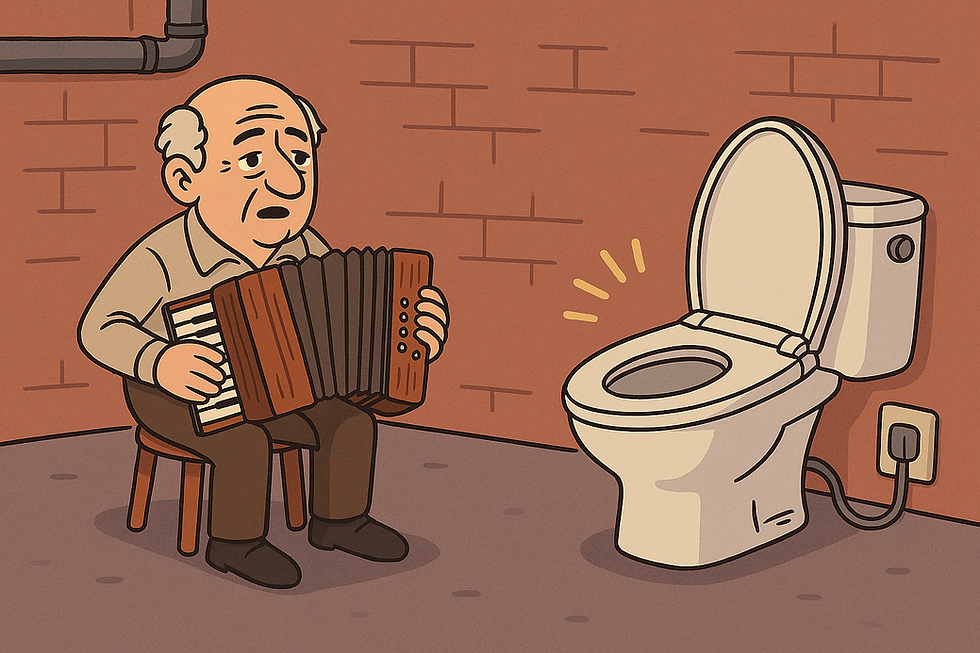
Like a man who invents the electric guitar and then says, 'Yes, very impressive, but I’ll stick with the accordion.'
Ironically, the Closomat company itself eventually struggled. A later model apparently malfunctioned so badly that even today it is spoken about in careful tones by the successor company.
But the invention survived.
In fact, shower toilets are now increasingly used in hospitals and care homes because they allow elderly or disabled people to use the toilet independently.
Which means Hans Maurer was ultimately proven right:
The strange basement man with the garden hose changed global bathroom culture.
And the story doesn’t end there.
Because another major toilet innovation also came from Switzerland.
The toilet duck.
Yes. The curved bottle designed to squirt cleaner neatly under the rim was invented near Zurich in 1980.
Apparently, while other nations were inventing space rockets and nuclear submarines, Switzerland quietly dedicated itself to optimising the toilet experience.
And honestly?
Considering the alternatives, that may have been the wiser choice.



Wait what?! I never knew. 😂