


POPULATION: IMPORTED
- rowiko2
- May 3
- 3 min read
Updated: Jun 21
Switzerland’s demographics and cultural evolution
In recent years, something has caught my attention whenever I visit Switzerland.
Increasingly, I’m greeted not in Swiss German, but in standard High German – proper, crisp, newsreader-level High German. In shops. In restaurants. On support lines. Everywhere.
For those unfamiliar: Swiss German is a spoken language, and it differs considerably from standard High German, which in Switzerland is mainly reserved for writing – and the evening news. They share the same roots, but the gap is large enough that a German dropped into a Swiss German conversation will understand approximately nothing, apart from the occasional ‘Danke’ – which in Swiss German is ‘merci’, which, of course, is French...
Most Swiss people, meanwhile, are slightly uneasy speaking High German. We grow up writing it, not speaking it. Fluency exists, but confidence is… negotiable.
So when I’m addressed in flawless High German in a Swiss café, I face a small but meaningful dilemma: do I respond in my native Swiss German and risk not being understood, or switch to High German and risk sounding like I’ve just learnt it from a textbook?
The reason for this recent linguistic shift in Switzerland is not particularly mysterious.
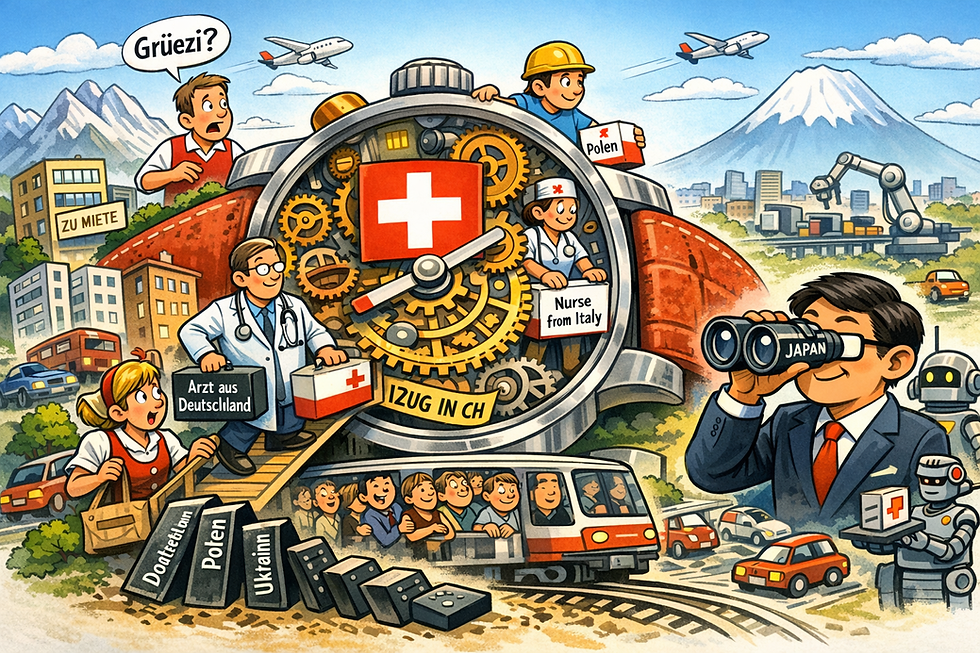
The percentage of the foreign population has risen from around 19% when I left the country thirty years ago, to 27% now. And the country depends on it.
Entire layers of the economy rely on people coming in from elsewhere.
It used to predominantly for jobs that Swiss people prefer not to do – construction workers, cleaners, etc.
Nowadays, it’s much more highly skilled specialists, managers, doctors, nurses.
Around 41% of doctors obtained their qualifications abroad. In some hospitals, it’s over half. And many hail from Germany.
Switzerland imports people the way it imports everything else it needs: efficiently, selectively, and in large quantities.
The underlying issue is familiar across Europe.
Switzerland, like many countries, isn’t having enough children. The fertility rate sits at around 1.29 – well below the level needed to sustain the population.
Left alone, the country would begin to shrink.
Instead, thanks to immigration, the current population of 9.1 million is projected to grow to over 10 million by 2050.
Which sounds manageable – until you experience it on a Monday morning train.
More people means more everything: more traffic, more pressure on housing, more crowded trains.
In Switzerland, there’s a term for this: density stress.
Rents rise. Commutes stretch. Infrastructure begins to groan slightly.
The system works – until it doesn’t. Because the people who arrive also age (as most of us tend to do). They, too, will one day draw pensions.
The solution, like many Swiss solutions, is precise, effective – and slightly temporary.
Across Europe, this creates a kind of demographic domino effect.
Doctors move from Germany to Switzerland. Germany fills the gap with doctors from Poland. Poland looks to Ukraine. Ukraine looks further east.
At the far end of the chain, somewhere in Central Asia, the dominoes simply stop – because there is no one left to move.
It’s globalisation, but with stethoscopes.
And what about Japan?
It faces a similar demographic challenge – but has chosen a very different response.
Instead of relying heavily on immigration, Japan has largely tried to manage decline internally: automation, longer working lives, and a cultural tolerance of exhaustion.
Where Switzerland imports workers, Japan refines endurance.
Where Switzerland fills labour gaps with people, Japan fills them – at least partly – with systems.
Both approaches make a certain kind of sense.
Switzerland says: if we need people, we will find them. Japan says: if we run out of people, we will… adjust.
Neither has solved the problem.
Europe’s population is expected to shrink in the coming decades. Switzerland may keep growing – for a while. Japan will continue ageing at remarkable speed.
And then there is the wildcard: artificial intelligence.
Optimists believe it will fill labour gaps and sustain economies. Pessimists believe it may remove the need for labour altogether – creating a world where technology takes care of things.
In which case, Japan may already be ahead.


Interesting.
When I’m in Switzerland, I say “Merci” and never speak High German.Not because I can’t, but simply because I don’t want to.
Even in the Netherlands, when I visit, more and more restaurant workers speak English instead of Dutch. Still, I speak Dutch there unless it’s genuinely impossible to communicate properly.
And did you know AI can already write in perfect Swiss dialect?
Maybe in the future, if we introduce AI robots, they’ll simply communicate with everyone in their own native language.