


NO PALACE, NO POWER, NO PROBLEM
- rowiko2
- Jan 10
- 3 min read
Updated: Jun 21
Swiss politics and humility from afar
On December 10, Switzerland’s parliament elected Economics Minister Guy Parmelin as president for 2026.
If your immediate reaction to this news was a polite nod followed by 'Wait, Switzerland has a president?'. Congratulations, you are responding correctly.
Because Switzerland’s presidency is one of the most Swiss things imaginable. It exists, it functions perfectly, and it makes absolutely no fuss about itself.
In most countries, becoming president comes with perks. Palaces. Motorcades. A private jet the size of a small village.
In Switzerland, if you are elected president and walk into the Federal Parliament building on the relevant Wednesday in December, you walk out… basically unchanged.
No extra powers. No palace. No police escort. No big red button labelled 'Presidential Authority.'
You still go home the same way you came in. Possibly by train.
The only noticeable differences are that your calendar gets busier, your home canton throws you a modest celebration, and you are now responsible for saying sensible, calming things on television on January 1st.
That’s it. That’s the job.
Switzerland’s government consists of seven people, collectively known as the Federal Council. They run the country together. No one is boss.
Every year, one of them becomes president. Not because they’re charismatic. Not because they won an election. But because… it’s their turn.
No campaigning. No slogans. No 'Make Switzerland Great Again' hats.
Just a calendar, a seating order, and a very strong sense of fairness.
The Swiss call this primus inter pares – first among equals – which is Latin for 'You’re chairing the meeting, don’t get carried away.'
This rotating system goes back to 1848, when modern Switzerland was founded.
The people writing the constitution had seen enough kings, emperors, and strongmen over the centuries and collectively thought: 'Let's not do that.'
The goal was stability, shared power, and making very sure no one developed delusions of grandeur – including themselves.
This makes Switzerland unique. No other country rotates its highest office automatically.
The Swiss president’s role is largely representative and not very glamorous. They travel abroad. They give speeches. But here’s the catch: every speech must be approved by all seven members of the Federal Council beforehand.
No freelancing. No improvisation. No 'I’ll just say what I feel in the moment.'
Interestingly, Switzerland never officially calls these trips 'state visits.' At home, they’re known as 'presidential visits' – which sounds just modest enough to feel comfortable.
Abroad, however, host countries tend to roll out the full red carpet anyway, because diplomatically it would be awkward not to.
The most visible moment of the Swiss presidency is the New Year’s address.
Every January 1st, the new president appears on television to calmly encourage compromise, dialogue, humility, and civic engagement.
This is not a command. It's more of a gentle suggestion.
No fireworks. No bold promises. No dramatic vision for the next decade.
Just: 'Let’s all try to get along, shall we?'
Very Swiss.
There is no personality cult. There are no re-election strategies. No power struggles. No desperate attempts to cling to office.
In a world where political leaders often arrive with grand visions and leave behind chaos, Switzerland quietly rotates its presidency like it’s changing the batteries in a smoke detector.
You barely notice it happening – but you’re glad it works.
The Swiss presidency is not designed to impress. It’s designed to work.
It is predictable. It is modest. Is is slightly boring.
And it has done its job without a serious institutional crisis for over 175 years.
Which is reassuring in a time of upheaval – and quietly makes me wish more countries would borrow a few pages from the Swiss manual of calm...

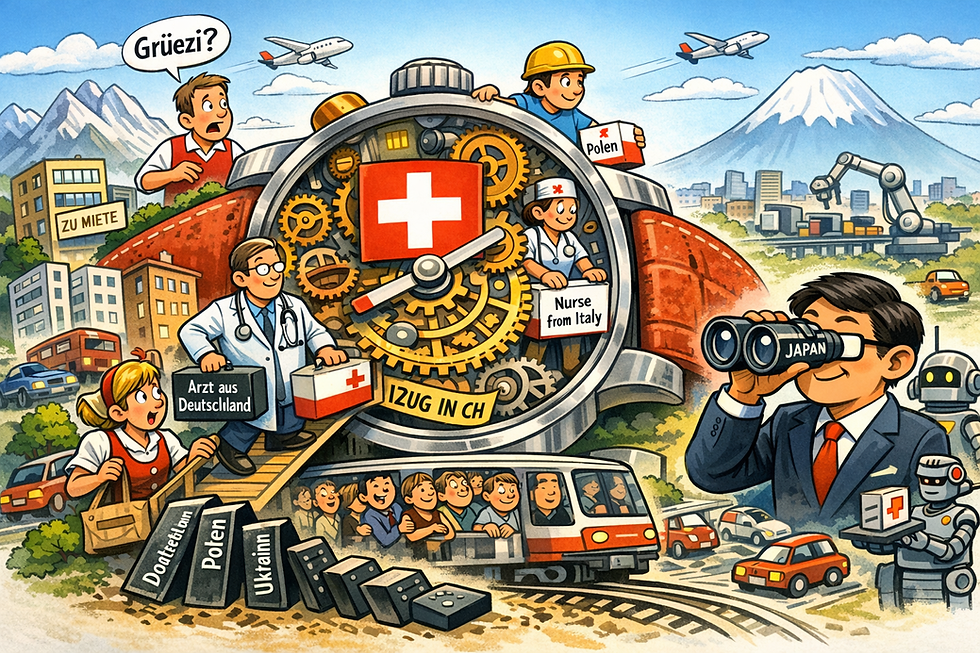

I totally agree, Rolf. I wish more countries would take Switzerland as a model, not only politically, but in how systems are run overall. Things work so well there that the Swiss sometimes seem to have to invent problems just to have something to complain about. 😆